

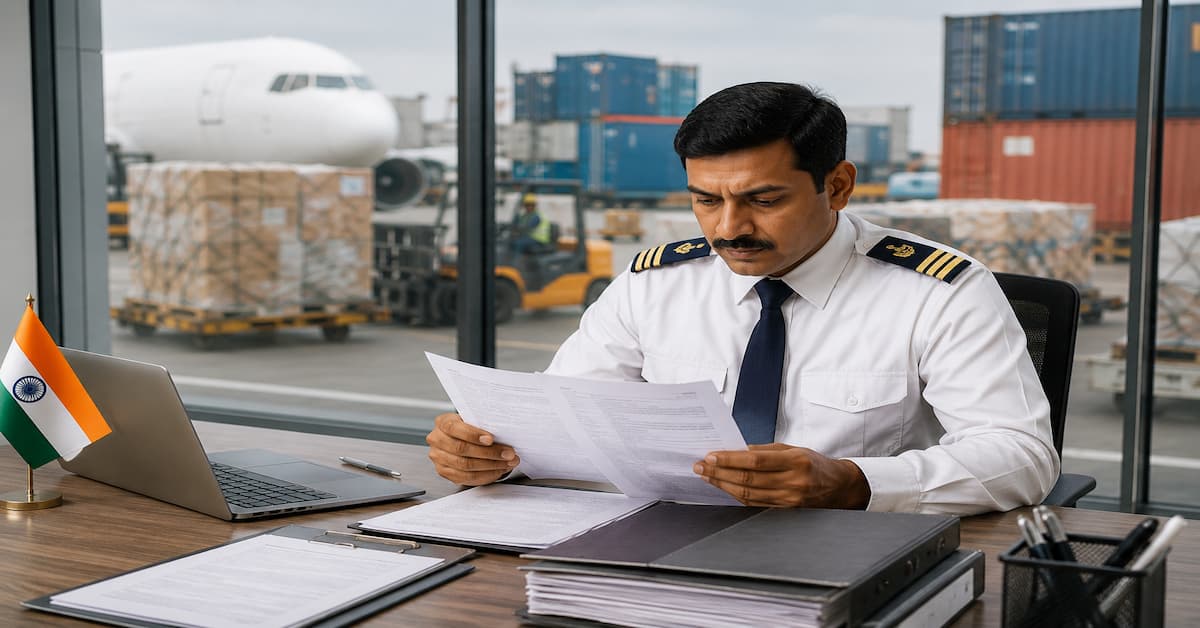
Your shipment has arrived at Mumbai port. Or Chennai airport. Or it is ready to leave India for a buyer in Dubai. Either way, nothing moves until customs clears it.
Custom clearance in India is no longer the paper-heavy, unpredictable process it once was. The entire system now runs digitally through ICEGATE — the Central Board of Indirect Taxes and Customs (CBIC) portal that handles every import and export declaration electronically. Paper-based processes have been completely phased out as of 2026.
But digital does not mean simple. Wrong HS Code classification, missing documents, or undervalued goods can still get your cargo detained — with penalties that start at two times the value of the goods in serious cases. This guide tells you exactly what to expect and how to get it right.
What is Custom Clearance and Why Does It Matter?
Custom clearance is the legal process of obtaining government approval to import goods into India or export goods out of it. It involves declaring your goods to customs authorities, submitting required documents, paying applicable duties and taxes, and having your cargo inspected and released.
Every single shipment crossing an Indian border — air, sea or land — goes through this process. There are no shortcuts. The question is whether it takes 24 hours or 24 days — and that depends entirely on how well you prepare.
How ICEGATE Works — India's Customs Digital System
ICEGATE (Indian Customs and Central Excise Electronic Commerce/Electronic Data Interchange Gateway) is the single platform through which all customs declarations in India are filed. Here is what you need to know about it before your first shipment:
- All import and export declarations are filed electronically — no physical submission
- Documents are uploaded through eSANCHIT — ICEGATE's document management module
- You need an active ICEGATE account with a valid Class 3 Digital Signature Certificate (DSC) linked to it
- The system uses a Risk Management System (RMS) to determine whether your shipment goes through Green Channel (auto-cleared) or requires physical examination
- Duty payment is electronic — NEFT, RTGS, or online banking
If your ICEGATE account is not set up and active before your shipment arrives, clearance cannot begin. This is the most common avoidable delay Indian importers face.
Documents Required for Import Customs Clearance in India
Every import shipment into India requires these core documents:
- Bill of Entry (BoE) — the primary customs declaration filed electronically via ICEGATE. Contains HS Code, declared value, quantity, and importer details
- Bill of Lading (sea freight) or Airway Bill (air freight) — issued by the carrier
- Commercial Invoice — from the exporter, showing goods description, unit prices, total value and currency
- Packing List — itemised contents, weight and dimensions of each package
- Import Export Code (IEC) — mandatory registration number from DGFT, quoted on all import documents
- Certificate of Origin — verifies where goods were manufactured; scrutinised more strictly since 2026 to prevent re-export of third-country goods
- Insurance Certificate — covers goods in transit
- BIS Certification (where applicable) — mandatory for regulated product categories under Quality Control Orders
For regulated goods — electronics, food, chemicals, pharmaceuticals — additional import licences or certifications may be required. Always verify before the shipment departs the origin country, not after it arrives at an Indian port.
Documents Required for Export Customs Clearance in India
- Shipping Bill — the export equivalent of the Bill of Entry, filed electronically on ICEGATE by your Custom House Agent (CHA) or freight forwarder
- Commercial Invoice and Packing List
- IEC Number — mandatory for all exporters
- GST Invoice with LUT (Letter of Undertaking) for zero-rated exports without IGST payment
- Certificate of Origin (CoO) — now issued digitally through the DGFT platform for preferential tariff treatment under trade agreements
- Letter of Credit (if payment terms require it)
- Export Authorization — required for restricted or controlled goods
The Custom Clearance Process — Step by Step
For Imports:
Step 1 — IGM Filing: The shipping line or airline files the Import General Manifest (IGM) when cargo arrives. Your shipment does not legally exist in the customs system until it appears here. No IGM means no Bill of Entry filing.
Step 2 — Bill of Entry Filing: Your CHA or freight forwarder files the BoE electronically through ICEGATE. India follows a self-assessment system — the importer initially self-assesses duty based on HS Code, declared value, and prevailing rates.
Step 3 — Risk Assessment: The RMS assigns a risk rating. Green Channel shipments get auto-cleared. Others go to Faceless Assessment — a digital review by customs officers without physical contact — or to physical examination if flagged.
Step 4 — Duty Payment: Basic Customs Duty (BCD), Social Welfare Surcharge, and IGST are calculated and paid electronically.
Step 5 — Out of Charge (OOC): Once duties are paid and assessment is complete, customs issues an Out of Charge order digitally. Goods can now be released from the port or airport.
For Exports: The process mirrors this but ends with a Let Export Order (LEO) — the customs clearance that allows your goods to be loaded onto the vessel or aircraft.
HS Code Classification — The Single Biggest Source of Customs Delays
The Harmonised System (HS) Code is an internationally standardised numerical code that classifies every product for customs purposes. It determines your duty rate, applicable restrictions, and whether your goods need additional certifications.
Getting the HS Code wrong — even by one digit — can result in wrong duty assessment, goods held for re-assessment, or in serious cases, penalties for misdeclaration. India's customs uses an 8-digit classification under the ITC-HS system.
Common HS Code mistakes Indian importers make: classifying finished goods under raw material codes to reduce duty, using generic codes instead of specific product codes, and applying the same code to product variants that have different classifications.
When in doubt, request a formal advance ruling from customs before your shipment moves. Shift My Cargo's customs team handles HS Code classification as part of our customs clearance service — reducing your misdeclaration risk to near zero.
Customs Duties in India — What You Will Pay
Import duty in India is not a single rate. The total duty burden is a combination of:
- Basic Customs Duty (BCD) — varies by product, typically 0–20%
- Social Welfare Surcharge (SWS) — 10% of BCD
- IGST — 5%, 12%, or 18% depending on product category
- Compensation Cess — applicable on certain goods like tobacco and automobiles
Total effective duty on many manufactured goods can reach 25–35% of the declared CIF value. Plan your landed cost calculations accordingly before committing to an import price.
5 Customs Clearance Mistakes That Cause the Most Delays
- Wrong HS Code — leads to duty reassessment and potential penalty for misdeclaration
- Undervaluation — customs authorities compare declared values against transaction value databases; significant discrepancies trigger detailed scrutiny
- Missing BIS certification — for regulated product categories, goods are held until compliance is demonstrated
- Inactive ICEGATE account — delays Bill of Entry filing from the moment cargo arrives
- Certificate of Origin issues — since 2026, Indian customs applies stricter scrutiny to CoOs, particularly for goods from countries with preferential trade agreements
Why Use a Custom Clearance Agent?
You can technically file your own Bill of Entry through ICEGATE. But customs clearance involves HS Code expertise, duty calculation, RMS risk assessment understanding, coordination with port/airport terminals, and response to customs queries — all under time pressure while your goods sit in a bonded warehouse accumulating demurrage charges.
A licensed Custom House Agent (CHA) like Shift My Cargo represents you before customs, handles all filings, responds to examination notices, and ensures your goods are released in the shortest possible time.
How Shift My Cargo Handles Your Custom Clearance
Our customs clearance team in Mumbai manages the entire process on your behalf — from HS Code classification and document preparation to ICEGATE filing, duty payment coordination, and cargo release.
- We represent you during customs examination — no need for you to visit the port
- We handle both import and export clearance across all Indian ports and airports
- We coordinate directly with shipping lines, airlines, and port terminals for smooth cargo release
- We work alongside our air freight, sea freight and cross-country shipment teams for end-to-end logistics under one roof
Whether you are importing machinery from Germany, exporting textiles to the UAE, or managing a complex supply chain with multiple international movements, our team ensures your customs clearance is handled correctly the first time. Contact us today for a free consultation.